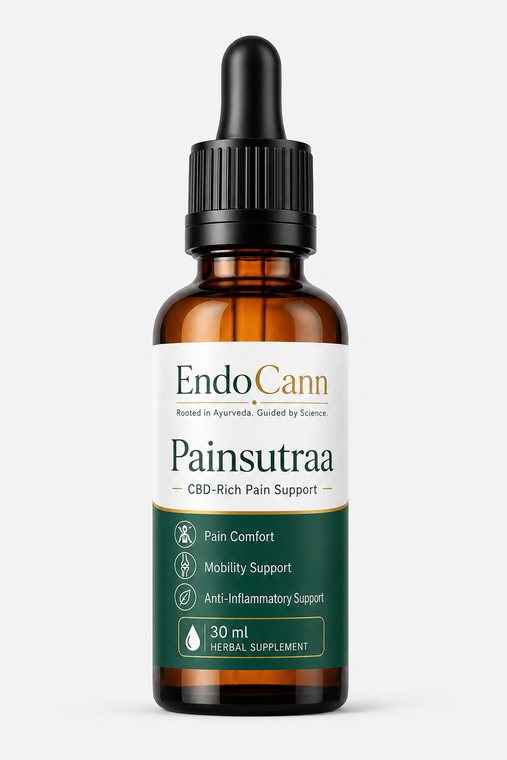
Pain & Inflammation
Clinical positioning
External-use massage oil applied around the pain region, including headache and migraine pain regions, as physician directed.
Clinical use lens
Local comfort and mobility cueUse where pain conversations need local comfort, movement support and anti-inflammatory botanical logic.
Protocol mapping
Indication fit
Pain-region comfort
Mobility support
Headache pain region
Migraine pain region
Why doctors reach for it
Clinical highlights
✦Topical application: a few drops around the pain region with gentle massage
✓Headache / migraine: apply around the relevant pain region only when physician directed
→Monitoring: record application area, frequency, local tolerance and response
How it is positioned to work
Mechanism map
1External botanical oil applied locally around the pain region
2Massage routine supports local comfort and mobility-focused care
3Not part of the edible or body-weight cannabinoid dose framework
Route boundary
Administration & dosing
↗
External pain-region application
PainSutraa is a topical massage oil, not an edible dropper dose.No X-based mg calculation
Pain regionApply a few drops around the painful region and massage gently.
Headache / migraineApply around the relevant headache or migraine pain region when directed by the treating doctor.
⏱
Timing and documentation
Document the pain region, frequency and response.
✓
Administration boundary
External use only. Do not swallow. It is excluded from X-based cannabinoid mg calculations.
Rx
Doctor instruction
Record the product, route, amount, timing, application or rinse method, duration and follow-up response.
In-clinic use
Correct administration & safety boundary
Correct administration
- Pain region: Apply a few drops around the painful region and massage gently.
- Headache / migraine: Apply around the relevant headache or migraine pain region when directed by the treating doctor.
- Classification: external / non-edible.
The X-based systemic dose framework is intentionally removed for this product.
Safety boundary
- External use only
- Do not swallow
- No body-weight cannabinoid mg calculation
- Document pain region, frequency and follow-up response
14 actives
Formula / ingredients
| Ingredient | Botanical / base | Part | Qty |
|---|---|---|---|
| Cannabis (Vijaya) | Cannabis sativa Linn | Leaves | 15gm (9.68%) |
| Lavender | Lavandula angustifolia Mill | Flower | 9gm (5.81%) |
| Eucalyptus | Eucalyptus globulus Labill | Leaves | 6gm (3.87%) |
| Rosemary | Rosmarinus officinalis Linn | Leaves | 6gm (3.87%) |
| Bala | Sida cordifolia L | Roots | 6gm (3.87%) |
| Karpoora | Cinnamomum camphora (L) J Presi | Extract | 3gm (1.94%) |
| Ginger | Zingiber officinale Roscoe | Rhizome | 2.5gm (1.61%) |
| Black Pepper | Piper nigrum Linn | Fruit | 2.5gm (1.61%) |
| Himalaya Pink Salt | Rock Salt | — | 2gm (1.29%) |
| Rosemary Essential Oil | Rosmarinus officinalis Linn | Essential Oil | 1ml (0.65%) |
| Karpoora Essential Oil | Cinnamomum camphora (L) J Presi | Essential Oil | 1ml (0.65%) |
| Wintergreen | Gaultheria procumbens L | Essential Oil | 0.5ml (0.32%) |
| Eucalyptus Essential Oil | Eucalyptus globulus Labill | Essential Oil | 0.5ml (0.32%) |
| Gingley Oil | Sesamum indicum Linn | Seed Oil | Q.S. to 100% / approx. 64.51% |
Clinic packs
Pack / MRP
| Pack | Strength | MRP |
|---|---|---|
| 30 ml | Clinical pack | Price on request |
Pack / MRP summary: 30 ml Price on request
4 source links
Audited research links
| Audited reference fit | Clinical logic | Source |
|---|---|---|
| CBD / cannabinoids ✓ Pain/inflammation checkedPMC full textMechanistic rationale CBD for Pain Treatment: Focus on Pharmacology and Mechanism of Action | Pain pharmacology and receptor mechanisms | Open ↗ |
| Cannabis active compounds ✓ Pain/inflammation checkedPMC full textMechanistic rationale Medical Cannabis Activity Against Inflammation: Active Compounds and Mechanisms | Anti-inflammatory active-compound mechanisms | Open ↗ |
| Lavender / linalool ✓ Calm/sleep checkedPubMed / PMIDScientific context Inhaled linalool-induced sedation in mice | Linalool/lavender calming adjunct context; not a primary analgesic proof | Open ↗ |
| Ginger / 6-gingerol ✓ Pain/inflammation checkedPubMed / PMIDMechanistic rationale Cyclooxygenase-2 inhibitors in ginger (Zingiber officinale) | Ginger COX-2 anti-inflammatory mechanism context | Open ↗ |
Educational use only. Doctor-facing scientific aid only. Research links are mapped for ingredient rationale, mechanism, clinical context and safety boundaries. This brochure does not replace diagnosis, standard-of-care treatment, regulatory prescribing rules or clinical monitoring. See our legal & medical disclaimer and editorial policy.
Same protocol