Feminine Wellness
Clinical positioning
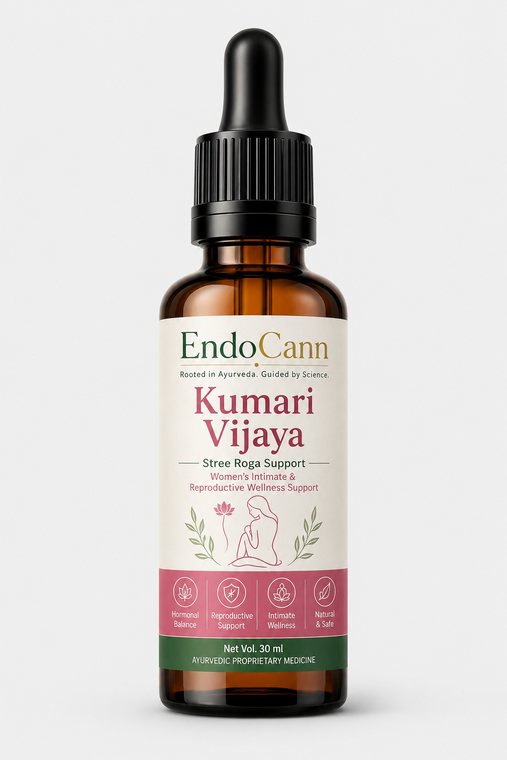
Women’s wellness support mapped for reproductive and menstrual wellness discussions; not positioned as infertility treatment or pregnancy-support claim.
Clinical use lens
Aloe + Vijaya support lensWomen’s and oncology-support adjacent positioning should remain conservative and symptom-support focused.
Protocol mapping
Indication fit
Women’s intimate wellness
Reproductive support
Hormonal balance
Natural care
Why doctors reach for it
Clinical highlights
✦Stree roga support: women’s intimate and reproductive wellness context
✓Classical blend: Kumari, Bhringaraja and Vijaya microdose logic
→Clinical use: physician-guided selection in appropriate women’s wellness protocols
How it is positioned to work
Mechanism map
1Kumari, Bhringaraja and classical botanicals support stree roga positioning
2Vijaya-containing microdose logic supports ECS-oriented comfort and calm
3Physician-guided women’s wellness support only
Physician-directed dosing
Administration & dosing
X
Dose framework
X = body weight in kilogramsFirst dose
≤ X/2 mgGrade-guided range
X–10X mg
≤ X/2 mgGrade-guided range
X–10X mg
First dose must never exceed X/2 mg total cannabinoids (equivalent to ≤0.5 mg/kg when X is body weight in kg). Further titration may move within X to 10X mg total cannabinoids only after tolerance and response review.
1–10
Indication grade
- Grade 1–10: set by indication severity, pain/inflammation burden, ESR, CRP and symptom trajectory.
- Adjust for age, frailty, secondary conditions, hepatic/renal risk, concurrent medicines and tolerance.
- Use follow-up response to hold, increase, reduce or discontinue.
↗
Titration model
- Incremental: gradual upward titration until response / tolerability.
- Incremental–decremental: step up, then reduce to minimum effective maintenance.
- Microdosing: very low divided exposure for sensitive, elderly or polypharmacy patients.
Rx
Administration
- Oral / sublingual / with suitable carrier as per physician direction and product format.
- Prefer consistent timing; document relation to food, sleep, pain peak, appetite or protocol goal.
- Document dose, route, time, food/carrier, indication grade, ESR/CRP or relevant markers, adverse effects and follow-up plan.
- Monitor sedation, dizziness, GI tolerance, cognition, drug interactions and functional response.
Full titration walkthrough: physician dosage guide.
In-clinic use
Doctor use notes & safety boundary
Doctor use notes
- Start low and titrate by clinical context, tolerability and symptom severity.
- Track response, co-medications, sedation, GI tolerance and follow-up outcome.
- Document dose, timing, duration, indication and review plan.
Safety boundary
- For registered medical practitioners only
- Select dose by clinical context and tolerability
- Monitor sedation, interactions and follow-up response
- Not for direct patient promotion
27 actives
Formula / ingredients
| Ingredient | Botanical / base | Part | Qty |
|---|---|---|---|
| Kumari | Aloe barbadensis | Leaf Juice | 0.53gm (8.89%) |
| Dhatura | Datura metal | Leaf Juice | 0.53gm (8.89%) |
| Bhringaraja | Eclipta alba | Whole Plant Juice | 1.07gm (17.75%) |
| Milk | — | — | 2.14gm (35.91%) |
| Yashtimadhu | Glycyrrhiza glabra | Root | 0.0083gm (0.14%) |
| Ushira | Vetiveria zizanioides | Root | 0.0083gm (0.14%) |
| Manjishta | Rubia cordifolia | Root | 0.0083gm (0.14%) |
| Musta | Cyperus rotundus | Rhizome | 0.0083gm (0.14%) |
| Nakha | Martynia annua | Fruit | 0.0083gm (0.14%) |
| Kapur | Cinnamomum camphora | Camphor | 0.0083gm (0.14%) |
| Bhangro (Vijaya) | Cannabis sativa Linn | Leaf | 0.0083gm (0.14%) |
| Ela | Elettaria cardamomum | Fruit | 0.0083gm (0.14%) |
| Harde | Terminalia chebula | Fruit | 0.0083gm (0.14%) |
| Padmakashth | Prunus amygdalus | Wood | 0.0083gm (0.14%) |
| Bhringaraj | Eclipta alba | Whole plant | 0.0083gm (0.14%) |
| Ardusi (Vasak) | Adhatoda vasica | Leaves | 0.0083gm (0.14%) |
| Talispatra | Abies webbiana | Leaves | 0.0083gm (0.14%) |
| Sarjrasa (Ral Sarj) | Vateria indica | Oleo Gum Resin | 0.0083gm (0.14%) |
| Tamalpatra (Tej Patra) | Cinnamomum tamala | Leaves | 0.0083gm (0.14%) |
| Vavding (Vidang) | Embelia ribes | Seeds | 0.0083gm (0.14%) |
| Suva (Shatpushpa) | Anethum graveolens | Fruits/Seeds | 0.0083gm (0.14%) |
| Aasod (Ashwagandha) | Withania somnifera | Roots | 0.0083gm (0.14%) |
| Eranda (Gandharv Hast) | Ricinus communis | Roots | 0.0083gm (0.14%) |
| Nyagrodhavata | Ficus bengalensis | Bark | 0.0083gm (0.14%) |
| Nadiyer (Narikel) | Cocos nucifera | Pulp | 0.0083gm (0.14%) |
| Oil (Taila) | Sesamum indicum | Oil | Q.S. to 100% / approx. 11.69% |
| Vijaya leaves/plant (Cannabis) | Cannabis Sativa Linn | Leaf Extract | 0.830gm (13.93%) |
Clinic packs
Pack / MRP
| Pack | Strength | MRP |
|---|---|---|
| 30 ml | Clinical pack | Price on request |
Pack / MRP summary: 30 ml Price on request
2 source links
Audited research links
| Audited reference fit | Clinical logic | Source |
|---|---|---|
| Cannabis / cannabinoids ✓ Boundary checkedNCBI / NCI boundaryClinical boundary Cannabis and Cannabinoids — NCI PDQ / NCBI | Authoritative supportive-care / symptom-boundary reference; not cancer-directed treatment proof | Open ↗ |
| Aloe barbadensis / Aloe vera ✓ Pain/inflammation checkedPMC full textMechanistic rationale Aloe vera: a short review | Aloe vera broad pharmacology, tissue-support and anti-inflammatory context; not infertility proof | Open ↗ |
Educational use only. Doctor-facing scientific aid only. Research links are mapped for ingredient rationale, mechanism, clinical context and safety boundaries. This brochure does not replace diagnosis, standard-of-care treatment, regulatory prescribing rules or clinical monitoring. See our legal & medical disclaimer and editorial policy.
Same protocol