Feminine Wellness
Clinical positioning
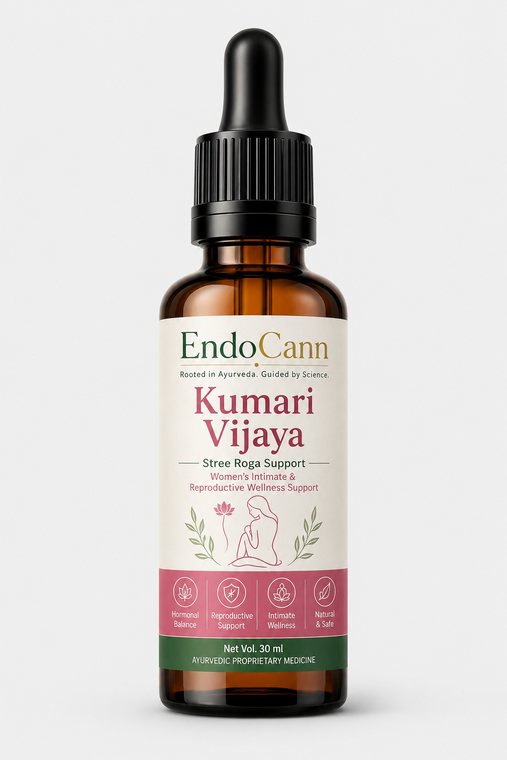
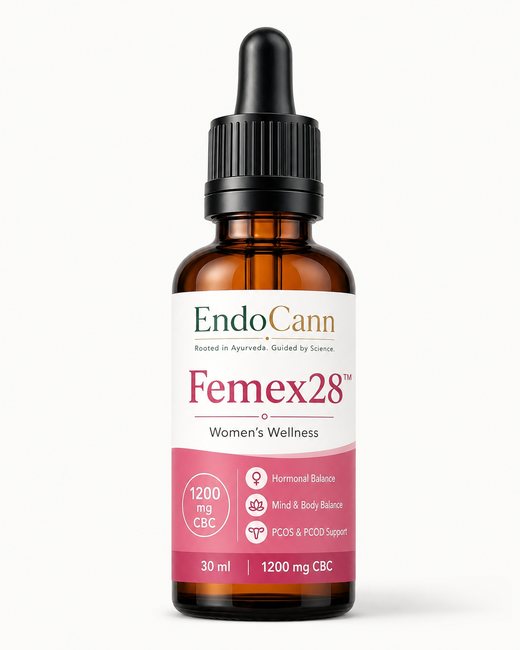
Women’s wellness formulation positioned for physician-directed menstrual comfort, hormonal balance and PCOD/PCOS support discussions; not infertility cure positioning.
Clinical use lens
Cycle-comfort and endocrine supportFor women’s wellness conversations around menstrual comfort, mood, PCOD context and hormonal balance.
Protocol mapping
Indication fit
Hormonal balance
Menstrual comfort
PCOS/PCOD support
Mood balance
Why doctors reach for it
Clinical highlights
✦Women’s wellness: menstrual comfort, mood balance and hormonal support context
✓Classical actives: Ashoka, Lodhra, Shatavari and ghrita-based formulation
→Low-strength cannabinoids: designed for gentle physician-led titration
How it is positioned to work
Mechanism map
1Ashoka, Lodhra and Shatavari support classical women’s wellness positioning
2Vijaya and ghrita base support mind-body and comfort pathways
3Antioxidant and inflammatory-balance support framed as adjunctive wellness
Physician-directed dosing
Administration & dosing
X
Dose framework
X = body weight in kilogramsFirst dose
≤ X/2 mgGrade-guided range
X–10X mg
≤ X/2 mgGrade-guided range
X–10X mg
First dose must never exceed X/2 mg total cannabinoids (equivalent to ≤0.5 mg/kg when X is body weight in kg). Further titration may move within X to 10X mg total cannabinoids only after tolerance and response review.
1–10
Indication grade
- Grade 1–10: set by indication severity, pain/inflammation burden, ESR, CRP and symptom trajectory.
- Adjust for age, frailty, secondary conditions, hepatic/renal risk, concurrent medicines and tolerance.
- Use follow-up response to hold, increase, reduce or discontinue.
↗
Titration model
- Incremental: gradual upward titration until response / tolerability.
- Incremental–decremental: step up, then reduce to minimum effective maintenance.
- Microdosing: very low divided exposure for sensitive, elderly or polypharmacy patients.
Rx
Administration
- Oral / sublingual / with suitable carrier as per physician direction and product format.
- Prefer consistent timing; document relation to food, sleep, pain peak, appetite or protocol goal.
- Document dose, route, time, food/carrier, indication grade, ESR/CRP or relevant markers, adverse effects and follow-up plan.
- Monitor sedation, dizziness, GI tolerance, cognition, drug interactions and functional response.
Full titration walkthrough: physician dosage guide.
In-clinic use
Doctor use notes & safety boundary
Doctor use notes
- Start low and titrate by clinical context, tolerability and symptom severity.
- Track response, co-medications, sedation, GI tolerance and follow-up outcome.
- Document dose, timing, duration, indication and review plan.
Safety boundary
- For registered medical practitioners only
- Select dose by clinical context and tolerability
- Monitor sedation, interactions and follow-up response
- Not for direct patient promotion
6 actives
Formula / ingredients
| Ingredient | Botanical / base | Part | Qty |
|---|---|---|---|
| Ashoka | Saraca asoca | Bark | 10gm (10 %) |
| Guda (Jaggery) | Jaggery | — | 4gm (4 %) |
| Shatavari | Asparagus racemosus | Roots | 0.5gm (0.5%) |
| Lodhra | Symplocos racemosa | Bark | 0.5gm (0.5%) |
| Bhang (Vijaya) | Cannabis sativa Linn | Leaf | 16gm (16 %) |
| Goghrita (Cow Ghee) | Cow’s ghee | — | 69gm (69 %) |
Clinic packs
Pack / MRP
| Pack | Strength | MRP |
|---|---|---|
| 10 ml | 400mg total cannabinoids≈ 2 mg/drop | ₹599 |
| 30 ml | 1200mg total cannabinoids≈ 2 mg/drop | ₹1,499 |
Pack / MRP summary: 10 ml ₹599 (400mg) · 30 ml ₹1,499 (1200mg)
4 source links
Audited research links
| Audited reference fit | Clinical logic | Source |
|---|---|---|
| Ashoka / Saraca asoca ✓ Women’s logic checkedPubMed / PMIDClinical context Effect of Saraca asoca (Asoka) on estradiol-induced endometrial hyperplasia | Ingredient-level uterine/endometrial support context; not PCOD or infertility proof | Open ↗ |
| Lodhra / Symplocos racemosa ✓ Women’s logic checkedPubMed / PMIDIngredient rationale Effect of Symplocos racemosa Roxb. on gonadotropin release | Ingredient-level FSH/LH endocrine-support context | Open ↗ |
| Shatavari / Asparagus racemosus ✓ Women’s logic checkedPMC full textIngredient rationale Standardized Asparagus racemosus root extract in PCOS-related endocrine dysfunction | PCOS endocrine-support context for Shatavari; not infertility cure claim | Open ↗ |
| Vijaya / cannabis active compounds ✓ Pain/inflammation checkedPMC full textMechanistic rationale Medical Cannabis Activity Against Inflammation: Active Compounds and Mechanisms | Cannabinoid anti-inflammatory mechanism context | Open ↗ |
Educational use only. Doctor-facing scientific aid only. Research links are mapped for ingredient rationale, mechanism, clinical context and safety boundaries. This brochure does not replace diagnosis, standard-of-care treatment, regulatory prescribing rules or clinical monitoring. See our legal & medical disclaimer and editorial policy.
Same protocol